Thursday, June 2, 2011

ode to rhubarb

I know that I am not the only one singing the praises of rhubarb, but please, humor me. Rhubarb, along with asparagus, is one of the first types of local produce to arrive at the farmers market here in my home state of Michigan. I watch for it, waiting in anticipation as the days get warmer, and then it finally appears, heralding summertime, whispering of all that is to come.

So naturally, I wrote you a poem about how much I love rhubarb. That's a perfectly normal thing to do, right?

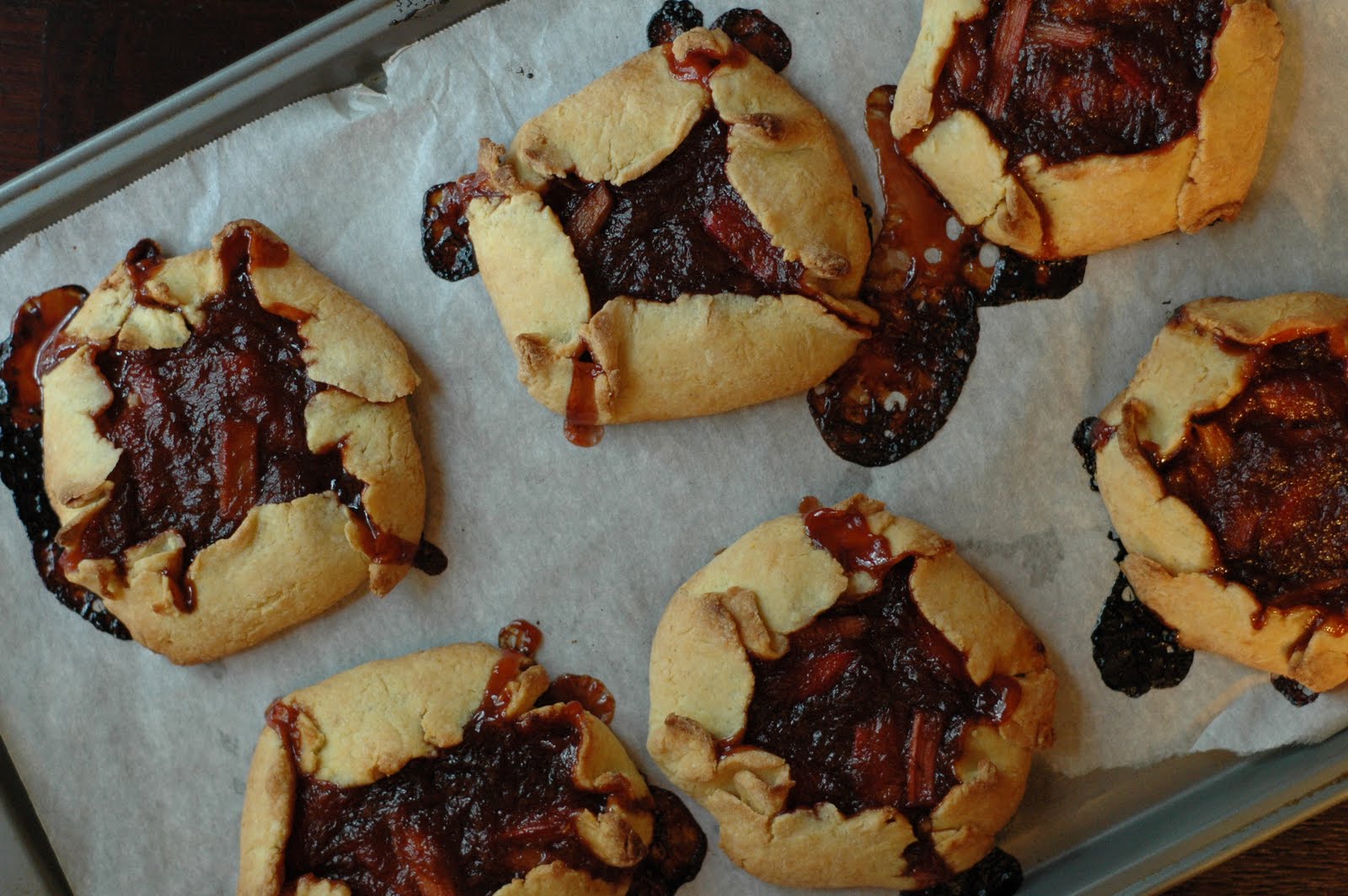
Roasted rhubarb, above, adapted from such recipes as those of Molly Wizenberg at Orangette and Luisa Weiss, the Wednesday ChefRhubarb tarts with a corn flour crust, below, from Kim Boyce's brillant Good to the Grain. This recipe can also be found online at the Smitten Kitchen.
Ode to Rhubarb

Your long stalks
Deepest red
Pink fading to green ends
They beckon me from where they rest
On the tables at the farmers market

And in an instant
I am dreaming of crisps and cobblers
Of warm, bright pockets of fruit
Encased within the crumb of a perfect scone
Or under the layer of brown sugar and butter
Topping my mother's quick bread,
Breakfast on the last days of school before summer
I am dreaming of ruby-red juices
Threatening to escape the confines
Of a small, misshapen tart
Which I will call rustic
In explanation of its imperfections

I am dreaming of filling my bright red pot
With chopped stalks
Of a matching hue,
Stirred with sugar and vanilla
And a splash of wine
(Red or white, I've yet to decide)
They will fall apart
And become, like magic,
Something I never know quite what to call
But will gladly put atop my oatmeal
And over ice cream and yogurt
And beneath soft pillows of whipped cream

I am pulled back to reality
As I hear the old man say,
Why not two pounds?
Why just one?
(I think to myself that
He is so thin
Like a stalk of rhubarb)
And standing there in front of his stall
Your beauty before me
I am easily convinced

As I leave the market,
My bag is heavy
And I open my heart
To summer

Thursday, May 19, 2011

run far. view tulips.

This past weekend was really lovely. On Saturday, I ran twenty-five kilometers with thousands of people through the streets of Grand Rapids and along its riverbank. That fellow of mine ran a slightly shorter distance, but I'm very proud of him nonetheless, because he's awfully fast, and, well, I love him (see below).

The race left me with the sorest legs post-race that I've yet experienced, a very black-and-blue toe (nothing new there) and, for several days, a pitifully slow stair-climbing pace. But once again, it was worth it.
Saturday afternoon, because I thought we ought to pack more activity into a day that began with many-mile-long races, we went to Holland, where we saw tulips in abundance.

They were beautiful.

Life is grand.

And this coming weekend, for the first time since late February, I will not be going on a ten-to-fifteen mile run! Oh, the simple pleasures.

May these spring days, my friends, be full of simple pleasures and the things that bring you joy, whatever those things may be--long runs (or short runs) and tulips and people you love, perhaps, or evening walks on warm spring nights and family and good food and laughter.

I hope that today, from your vantage point, life seems quite grand indeed.

Tuesday, May 3, 2011

easter part two: sunday comes

During a very long run on Good Friday under drizzling, gray skies, I listened to a sermon preached the Sunday before, the last in the Lenten series of a nearby church. The pastor, in his prayer before the sermon, noted the dark days before Easter and the celebration of that bright day that follows. He prayed, "As we enter into a Friday that leads to a Sunday, we ask you to give us that hope that whatever that Friday looks like, Sunday's coming."

For not the first time, a sermon by this particular fellow had me nearly had me in tears as I rounded Reed's Lake in my well-worn running shoes. As I ran under actual dark skies, my thoughts muddled and my heart weary, the parallels couldn't have been much clearer.

And as much as it never feels true during the dark days, he is right: Sunday comes; it always does.

But those dark days can be so hard. I struggle to get through them with hope still intact that Sunday is on its way.

In these two years since graduating from college, as I've begun my life out in the great big world, if I have learned anything, it is that life is hard. There are dark days, and lonely days and sad days and confusing days and days that are just plain hard. Life entails difficult decisions and reasons to cry and hurting people and a broken world.

But. In addition to being hard, life is also good. It is full of hope and promise.

Sunday always comes.

And so it did that weekend. Following the Good Friday of that wet and dreary run, Easter Sunday came with warmth and sunshine, the physical reminder of Resurrection. Ben and I enjoyed a lovely day with his family, and his sister's twin daughters--two very small people full of simple joy, with yet-unknown-but-surely-beautiful futures ahead of them--further reminded me that there is much for us to hope for.

In my life at present, I'm still rather stuck in the middle of a Friday, waiting for a Sunday. The rain comes and goes, and sometimes blue skies peak through the clouds. Yet a haze covers most of my future, and sometimes I lack even the smallest degree of clarity. But that's okay. I am still happy, and I am hopeful. The sunshine and the answers and the next pages in my story will come.

And for you also, whatever you may be experiencing, I know that those things will come.

There is hope. Sunday is coming. Christ is risen.

So whether you are celebrating a bright Sunday morning or waiting in the dark, I offer you this salad, which is full of brightness and tastes of springtime. This was my contribution to our celebratory meal on Easter Sunday, and, if I may say so, it's quite wonderful. The recipe below provides loose guidelines and makes an enormous amount of salad, so use what you have or can get your hands on, make as much or as little as you'd like, improvise as you see fit and enjoy with people you love.
Spring Sunday Salad
Adapted from Heidi Swanson at 101 Cookbooks

For the salad:
3-6 cups cooked wheat berries (or substitute farro, which to my dismay I never can find, or pearled barley or even rice)
2 cups cooked yellow split peas
1 1/2 cups green peas, fresh if it happens to be the right season, frozen if not
4 large handfuls of mixed salad greens
1-2 cups baby tomatoes
1/4 cup feta cheese, crumbled

For the Citrus Parmesan Vinaigrette:
1 orange
1 shallot, chopped
1/3 cup Parmesan cheese
1 tablespoon white wine vinegar or lemon juice
1/2 cup olive oil
salt and pepper

To cook the wheat berries, in a large saucepan, combine 2-4 cups of wheat berries with water to cover by at least an inch and a large pinch of salt. Bring to a boil and then lower heat; cover and simmer until the wheat berries are plump and chewy, about an hour. Drain and set aside.

To cook the yellow split peas, place 3 cups of water in a large saucepan and bring to a boil. Add 3/4 cup of dried yellow split peas and simmer until the peas are tender, 20-30 minutes. Drain, salt and set aside.

To prepare the green peas, boil briefly in salted water. Drain and set aside.

To prepare the tomatoes, douse generously with olive oil, sprinkle with salt and roast in the oven at 350 F until wrinkled and beginning to caramelize.

To make the dressing, whisk the zest and juice of the orange with the chopped shallot, Parmesan cheese, vinegar or lemon juice and olive oil. Add salt and pepper to taste.

Finally, assemble the salad! In a large bowl, toss the wheat berries, yellow split peas and green peas with a few spoonfuls of the Citrus Parmesan Vinaigrette until everything is thinly and evenly coated. Add the greens and tomatoes; toss gently. Add salt and more dressing if necessary, toss one last time, place in a pretty bowl or on a pretty platter and top with the feta cheese.

Then, enjoy, my friends--Sunday's coming!

Serves eight or more.

Tuesday, April 26, 2011

easter part one: tradition, food and family

Part one of my Easter celebration occurred a week early, on Palm Sunday weekend, when Ben and I visited Midland to celebrate with my parents. We made the traditional croissants and a lovely savory tart--now an official tradition as well, I imagine, as it's in its second year (this is the vegetarian substitute for the ham of my childhood, and let me note that my omnivorous parents welcomed the switch and suggested this year's repeat...either it's that fabulous or they love me that much. Perhaps both.)

We are big on food traditions in my family, a fact I am only now beginning to realize. Along with recognizing the reason for the holiday itself, our celebrations primarily involve (1) good conversation and (2) food.

When I read food writers I admire, I sometimes think that I just don't fit the mold: I love food; I think about it all the time and wrap stories around meals in my mind. But I don't have a background characterized by the interweaving of cultural heritages, my mother's family is not Italian with a signature red sauce for proof and my father didn't have any kind of culinary identification with a place so romantic as Paris.

But my parents are both excellent cooks. My childhood was marked by my mother's muffins, loaves of honey-wheat bread, macaroni and cheese, strawberry freezer jam and summer fruit crisps, all from scratch. Her incredible birthday cakes reflected my interest of the moment, be it Minnie Mouse, butterflies or basketball.

In our household, refried beans were made from scratch, though I don't think I realized that the alternative to the beans simmering on the stovetop was encased in a can. My dad specializes in Mexican food and throws down a fabulous pizza. Though more a cook than a baker, he makes an oatmeal bar layered with chocolate that is absolutely divine.

As I was growing up, we ate dinner together, at home, nearly every night. My sister and I delighted even in simple foods, like crackers topped with cheese melted under the broiler. (And I had no idea how blissfully inexpensive the meal was for our young parents.)

My mom occasionally threw tea parties for us. We wore hats, and she made scones with clotted cream and cucumber sandwiches. I loved the perfect lines of the sugar cubes stacked in their tiny white bowl, and we sipped our tea from the beautiful and fragile teacups of my grandmother's collection.

On our birthdays, we got to choose the menu for dinner (my longest-running choice was my mother's famed chicken and broccoli casserole accompanied by homemade rolls), and each holiday was associated with particular meals and desserts. Unconsciously, I spun these traditions together in my mind. My dad made fudge and party mix only at Christmas and cracked hazelnuts with us for his family's signature holiday cookie; my mom took charge of the intricate Santa cookies and the spritz and the Christmas morning cinnamon roll wreath. On Valentine's Day, she made heart-shaped sugar cookies, decorating them for our school parties with designs in pink and white and light purple frosting. We froze red Kool-Aid to make heart-shaped ice cubes and dropped them in Sprite.

Springtime brought thumbprint cookies with frosting in pale shades of yellow, pink and green. And on Easter, we ate ham with canned cherries atop, twice-baked potatoes, homemade croissants with jam and a bunny-shaped carrot cake for dessert. My sister's blog confirms that both offspring of this family still equate thumbprint cookies, those buttery croissants, asparagus and carrot cake topped with cream cheese frosting with the celebration of springtime and Easter.

In my love of stories, I sometimes miss or discredit my own. And perhaps we have to be adults to truly reflect the influence of our pasts; we have to live long enough to see the story begin to unfold. But these days, as I make my own choices and actually pay attention to them, I am realizing that a significant part of what defines my sense of family, tradition and celebration is food, and this isn't something new to this season of my life. Instead, it's woven throughout my past, just as it is for the aforementioned writers I admire.

I found peace in the food traditions that remained constant for our displaced celebration of Easter. And there is something deep that these food traditions communicate--that you celebrate, because life is hard, and celebration helps; that there are things we can rely on, like food and like family; that food not only sustains us but also, blessedly, can be enjoyed communally, in celebration, with the people we love.

And all of this, as it turns out, I learned from my family as well.